
My school offered a trip to Costa Rica where we were introduced to field research! We visited the rainforest and saw many cool plants and animals. Our teacher said that we were the luckiest out of all the groups that she has taken! We did a lot of interesting research activities at various locations.
1. Probably the most unique experience we had was being able to release a baby leatherback turtle in Pacuare. Costa Rica has many beaches where sea turtles come and lay their eggs. After a few months, the eggs hatch and the turtles crawl into the ocean. However, there are many poachers who sell turtle eggs because they are highly profitable. We visited two organizations at Pacuare who take turtle eggs once they’ve been laid and put them in nurseries to prevent poachers from taking them. Once the eggs hatch, they release the turtles on the beach so they can walk into the ocean.
Although we didn’t get to see eggs hatching, we did get to release a baby leatherback turtle into the ocean, which was really special! Although leatherback turtles can grow to be 2000 pounds, the baby was less than the size of my hand. Since it isn’t built to walk on land, when it crawled through the sand it looked almost as if it were trying to swim through the sand. This turtle was weaker than the rest, so we had to wait awhile for it to reach the ocean.
Another interesting thing we saw was bioluminescent algae in sand. When we kicked the sand, we could see little dots glow in the sand, so it was as if we were looking at stars in the sky! Although I couldn’t take any photos, our night on the beach was definitely a once in a lifetime experience and something I’ll never forget.
2. Our local guide in Sarapiqui is an expert in bats, so we did some very interesting activities with bats. Many bats make tents out of leaves by making designs out of holes so that they fold in a specific way, so one day we went to primary and secondary forests to look for bat tents. We found many bat tents and wrote down the specific type of tent that they were. Two of the tents that we saw even had bats inside them!


We found tents with Great Fruit-Eating Bats and Honduran White Bats. I also spotted a poisonous snake right next to the trail!

Later we analyzed whether there was a difference in the number of types of bat tents between primary and secondary forests. Our null hypothesis was that there was no difference, but we ended up rejecting the hypothesis, as some tents appeared more frequently in primary or secondary forest.
At night, he used a mist tent and caught a bat, so we were able to look at the parts of its body. The bone structure was surprisingly similar to a human’s. He also shined a flashlight into its wings, so we could see the veins inside. That was definitely a special experience.

3. Another activity we did was with strawberry poison dart frogs. Our hotel was situated in the jungle, so there was forest all around us where we could find frogs. I honestly wasn’t expecting to be able to find poison dart frogs so easily, especially since they are so tiny, but it was pretty easy to identify their call and locate them.

We were recording the frogs’ responses to visual and auditory stimuli, so we made model frogs with clay and played a recording of the frog’s call. Interestingly enough, the frogs completely ignored the models, but they responded to the recordings of the calls and would jump all over our phones, which were playing the recordings.
4. Our last activity at Sarapiqui was an experiment that we designed on our own involving leafcutter ants. Leafcutter ants can be seen walking along their own trail carrying leaves that are quite large proportional to their body size, because they use the leaves to grow a type of fungus that they consume.
In our experiment, we took leafcutter ants and moved them away from the trail at varying distances and terrains to see how the speed at which they return to the trail would be affected. Some of the ants took a really long time to return, and sometimes I lost track of the ant among the grass, but my friends and I sang songs to pass the time.
Later we made box plots and tables to analyze our data, and we gave a presentation to our classmates. Although it was quite laborious, being able to do our own experiment was definitely very fun, and it was one of my favorite activities that we did on the trip.

After Sarapiqui, we went to UGA Costa Rica in the Monteverde Cloud Forest Reserve. The cloud forest is much cooler than the other parts of Costa Rica we had been in (and with significantly less mosquitos!). We did many activities lead by some very qualified scientists! One short activity we did involved mapping all the trees in a 25 by 25 meter square and wrote down the radii of the trunks and branches over 10 centimeters.
We also did an activity where we had our students and some university students and staff throw sticky balls at a target to measure the accuracy and precision of the throws. My group analyzed how age affects accuracy, and we had to do lots of calculations and number crunching! We ended up learning a lot during our time there.
Not quite science related, but while exploring the rainforest, we saw a lot of amazing animals, especially in Pacuare. We saw 3 different kinds of monkeys and 2 toucans in one boat ride alone, and on one of our night boat rides our guide reached into the water and pulled out a baby caiman! I’ll put some photos of the cool things we saw.

We saw quite a few green basilisks. They are called the “Jesus Christ Lizard” because they can walk on water!

We also saw many capuchin monkeys. While we were birdwatching we got to see these monkeys displaying human-like behavior!

Our guide pulled this baby caiman out of the water!

Howler monkeys have a distinct call that you can hear from far away. We saw quite a few of them.

We also saw many iguanas. One of them was very high up in a tree!

At the cloud forest we went to a hummingbird garden with many species of hummingbirds. They were very hard to photograph because they move so fast!

We were able to see two-toed and three-toed sloths. The 10000 colón note has a drawing of a sloth on it!
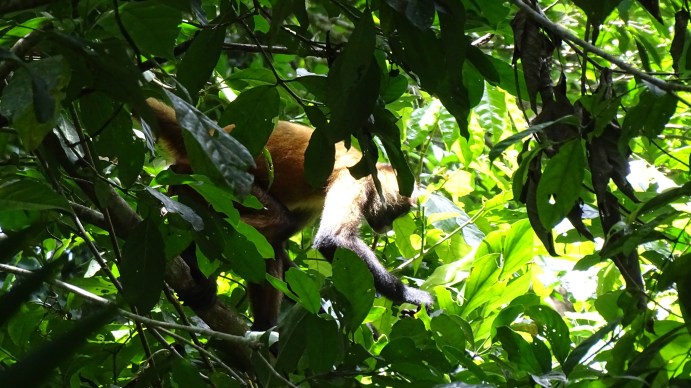
Spider monkeys can be seen jumping and swinging from branch to branch!

We saw two aracari toucans on a boat ride! The most notable toucan is the keel-billed toucan, which has a rainbow beak, but we were unable to see it.
Overall, the Costa Rica trip was very interesting, and we definitely had many experiences that I would otherwise never be able to have, like being able to learn from a number of qualified scientists. It was a trip that I will definitely remember vividly!
The picture of the bats clustered like fruit under the leaves was really startling! Were you scared at all?
How did you get so close to all the animals; aren’t they scared of people?
It must have been amazing to see the baby turtle struggle to reach the water 🙂
>:)